Time Person of the Year, 2010

So, the nominations for Time magazine’s Person of the Year are out.  When did they start releasing nominations prior to the announcement of their choice?  This seems like a bad idea.  I know that, ultimately, the magazine’s editors are still deciding who gets the title, but why even let people pseudo-vote on this?  Why even allow for the possibility of the public influencing editorial decision-making?

Besides, we all know how this is going to go.  Stephen Colbert proved long ago the futility of asking the Internet’s opinion about anything.  If Time had shown me the list of nominees beforehand I could have told them who would end up dominating in the Facebook “Like” race.  Isn’t that right, Little Monsters?

Picture 9

Don’t get me wrong, I’m not naive; I realize Time is just doing this to drive page views, and obviously it’s working.  I just clicked through all twenty-something pages of the gallery.  Congratulations, Time!  That doesn’t stop me from being annoyed by the whole thing, though.

Also annoying to me, and likely to Time as well, is how people constantly misunderstand what this even means.  It’s not a commendation; it’s supposed to go to the biggest newsmaker or the person with the most influence, positive or negative, in that calendar year.  No, LeBron, this isn’t some sort of global MVP award, you don’t need to be falsely humbled to be included along with the Chilean Miners.

Picture 7

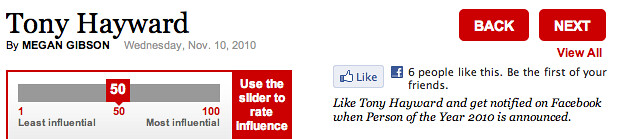
Someone should tell him that one of his fellow nominees is Tony Hayward.
Picture 10

(As an aside, who are the six people that liked Tony Hayward’s nomination on Facebook?  What would possess one to do that?  It has to be hipsters “liking” it ironically, right?  “Liking” Tony Hayward on Facebook is the digital equivalent of wearing an old Bryant Reeves Grizzlies jersey to a Wavves concert.)

Continue reading

First Impressions

The other day, in response to “Like” buttons popping up all over the internet and Facebook officially staking its claim as the future overlord of our online lives, I thought it would be fun to dig up an article from my college newspaper published immediately after the University of Chicago was brought into the then-exclusive Facebook world.  It’s funny to think about a time when we were still calling it thefacebook.com, you had to have a legitimate email address from a small group of approved schools to join, and none of us could really see much of a future for it.

That didn’t stop us from checking it obsessively, adding people as “friends” that we hadn’t spoken to in years, and following along with Zuckerberg as he added photo albums, status updates, and a news feed to our lives.  Sure, we complained about every change (one would think we would have learned to trust them), but we kept going back, and now, six years later, Facebook has passed Google as the most visited web site in the United States.

Anyway, reading that old article got me thinking about first impressions for other things in our lives that we now take for granted.  Now that all these old articles are archived, mostly for free, online, it’s easy to go back and see what we thought of these unfamiliar items and people when we first came into contact with them.  Almost all of the articles cited here are from The New York Times, mostly because its archive is so conveniently comprehensive and easy to search.  Let’s start with something that I now own six of (not all of them still functioning).

The iPod

DSC02322

A lot of the initial press that the iPod generated seems sort of laughably understated today, but it made sense to not freak out about it when it was introduced.  It’s not like Apple invented digital music files, after all, and the Mac exclusivity at the time did severely limit the market, especially considering that a lot fewer people had Macs back then (Johanna and I are both examples of recent converts).

That said, shouldn’t we have known this was a big deal?  I mean, it was inevitable that Apple would make a PC-friendly version, right?  The closest this NYTimes article comes to speculation about that possibility is this sentence: “Apple said it had not yet decided whether to introduce a version of the music player for computers with the Windows operating system, which is used by more than 90 percent of personal computer users.”

Continue reading